
The New Brain Drain: Why Developing Countries Are Losing Talent to Remote Work
Remote work was hailed as a global equalizer, but for developing nations, it has accelerated a dangerous new form of brain drain. Discover why top local talent is now choosing high-paying foreign employment without ever leaving home.
Sid
10/31/20253 min read

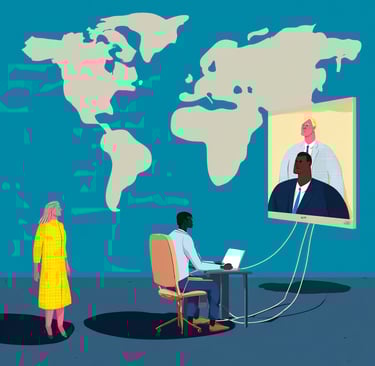
For decades, the concept of brain drain was intrinsically linked to physical migration. The familiar scenario involved a highly skilled doctor, engineer, or academic leaving their home country in the developing world to physically relocate to a Western nation, seeking better pay, advanced opportunities, and a higher standard of living. This exodus represented a significant loss of human capital and a major setback for the development prospects of the nations they left behind.
The rise of widespread, high-speed remote work was initially championed as the solution to this problem. The hope was that professionals could access global opportunities and competitive salaries while remaining in their home countries, spending their foreign earned income locally, and contributing to the domestic economy. This was supposed to be the great equalizer, reversing the flow of talent. Instead, remote work has ushered in a new and accelerated form of brain drain, one where the talent remains physically present but is functionally and financially disconnected from the local economy and labor market. They are present in body, but absent in economic contribution.
The primary driver of this new brain drain is the massive and immediate wage disparity that remote work exposes. A software engineer in a developing country might earn a salary that is locally competitive but is only a fraction of what a peer with the same skill set earns in a major technological hub like Silicon Valley or London. Remote work allows that local engineer to secure a job directly with the foreign company, often for a salary that is two, three, or even five times what any domestic employer could offer. This immediate and significant financial leap is an irresistible force, effectively vacuuming the top tier of local talent out of the domestic labor market.
This flight of top talent creates a cascade of devastating effects on the developing nation's economy. The most immediate impact is the stagnation of domestic innovation and productivity. Local companies, startups, and public institutions are now unable to compete for the best employees. They are left with a smaller pool of skilled workers who often demand higher salaries due to the remote competition, squeezing local business margins and slowing the pace of technological development and expansion within the country. Crucial sectors, from fintech to healthcare technology, find themselves critically understaffed, not because the talent doesn't exist, but because it is working full time for a foreign employer across time zones.
Furthermore, this new dynamic creates a severe wage inflation crisis for domestic companies. While the high salary is wonderful for the individual remote worker, it warps the local labor market for everyone else. When a local company tries to hire, they are forced to offer salaries far exceeding previous market rates just to attract moderately skilled workers. This raises the operational costs for domestic businesses, many of which are already struggling, making them less competitive and often forcing them to halt expansion or even close down. The pressure this places on the local economy and its ability to create stable, scalable businesses is immense.
Another critical consequence is the weakening of the local professional ecosystem. Traditional physical brain drain removed the individual but left the local institutions intact. Remote brain drain leaves the individual but hollows out the domestic professional community. Top local talent no longer participates in local industry conferences, mentors local university students, or, crucially, finds and invests in local startups. Their entire professional network, their focus, and their career growth are oriented toward their foreign employer. This severs the organic ties that allow knowledge, capital, and mentorship to circulate and nourish a growing local economy, turning the most skilled individuals into isolated, high income islands.
Governments in developing nations are struggling to find policy solutions to this largely invisible, non physical form of migration. Traditional measures like incentivizing return migration are useless because the talent never left. Simply raising taxes on high income earners risks pushing the talent to move to nations with friendlier tax laws, as their income is tied to a global source. The challenge is complex, requiring a blend of strategic action: massively increasing investment in local education and training to rapidly expand the talent pool, offering targeted tax breaks and subsidies to domestic companies that can prove they are generating high value intellectual property, and even exploring international agreements to ensure fair contributions to local social security and tax systems from foreign remote employers.
The romantic ideal of remote work as a solution to global inequality has proven to be a complex reality for developing countries. While it offers incredible opportunity for a select few, it exacerbates inequality within the nation and undermines the collective economic potential. The new brain drain is a subtle, yet powerful, force that is quietly siphoning the most valuable resource a developing country has: the ambition, skill, and ingenuity of its best and brightest, who are now digitally employed elsewhere. The talent is home, but their loyalty and economic contribution are firmly abroad, making this perhaps the most challenging developmental hurdle of the digital age.